
Most freelancers and small professional-service owners I talk with have the same quiet confession. They spent a weekend building an AI-assisted workflow that felt brilliant on day one. By week three the system was collecting digital dust. By month two they were back to copy-pasting the same email replies and hunting through threads for the latest client note.
This is not a story about technology failing. It is a story about systems that were never designed to be lived with.

The Hidden Cost of Abandoned Systems
When an AI workflow dies, the damage is rarely dramatic. You simply stop opening the dashboard. You stop trusting the output. You start doing the work the old way while the half-finished automation sits in the background like a broken appliance you keep meaning to fix.
Trust Erodes Quietly
The real cost is trust. After two or three abandoned experiments, many owners conclude that AI is simply not for their kind of business. That conclusion is expensive. The problem was almost never the tools. The problem was the design. I learned this after leaving a regional consulting firm and beginning to help solo operators. The systems that survived were never the most sophisticated. They were the ones the owner could still explain, repair, and safely adjust six months later.
Novelty Masks the Weakness
The first thirty days of any new AI setup feel productive for predictable reasons. Novelty supplies energy. You are still curious enough to check the outputs carefully. The volume of work is usually low while you are testing. You are the only person using the system, so every edge case remains visible. Those three conditions disappear quickly. Client load returns. Curiosity fades. Edge cases multiply. If the system was never built to survive that transition, it fails.
The Prototype Problem
Most people treat the first version as finished. In reality it is a prototype. A prototype that is never stress-tested against real client volume, tired evenings, or a tool change will not last. The owners who keep their systems are the ones who deliberately design for the version of themselves who will be busy and slightly skeptical three months later.
Five Common Failure Patterns
These patterns appear again and again in the practices I review. Recognizing them early is the fastest way to stop wasting effort.
Invisible Boundaries
Many workflows begin with a vague instruction such as “summarize client emails” or “draft a proposal from the discovery notes.” The AI produces something that looks useful. The owner accepts it. Then a client mentions a sensitive detail, a pricing exception, or a scope change that never made it into the notes. The system has no clear boundary for what belongs in the automated path and what must stay human. Without an explicit rule, the automation either becomes too cautious to be useful or too aggressive to be safe. Most owners simply stop using it rather than tightening the boundary. A maintainable system states the boundary in plain language before any tool is chosen.
Missing Human Checkpoints
The second failure is the absence of a named review step. The workflow generates a client update or a revised scope document and the owner assumes the output is ready to send. When a factual error or an awkward tone appears, confidence collapses. Human review is not a luxury. It is the mechanism that keeps the system honest. Every maintainable workflow includes at least one checkpoint with a clear question the human must answer before anything leaves the building.
Tool Sprawl Without Ownership
It is easy to connect five tools in an afternoon. Each connection feels like progress. Six weeks later the owner cannot remember which tool owns the source of truth for client status. When something breaks, diagnosis becomes archaeology. The simple rule that prevents this is that every workflow must have one clearly named source-of-truth document a human can open and understand without opening any other tool. Everything else is a helper.
Zero Maintenance Design
Most AI systems are built as if they will never need attention again. Real businesses change. Pricing shifts. Service offerings evolve. A new team member joins. An old tool changes its interface. Without a written maintenance plan, the system becomes brittle. Before any workflow is considered finished, four questions must have written answers: what will signal unreliable output, who may change the logic, how often the full flow will be reviewed, and how the work can still be finished manually if the automation fails.
Automation Before Observation
The final and most common mistake is automating a process the owner has not yet watched carefully. Someone reads about a clever intake system and immediately tries to replicate it. They have never timed their own discovery calls, never listed the questions that predict a good client fit, and never noticed where information routinely disappears. Before you automate anything, watch it happen three times with a notebook. Write down the friction. Only then decide what, if anything, deserves a tool.
How to Design Systems That Last
A maintainable AI system is deliberately modest. It solves one recurring operational problem. It explains the workflow in plain language before naming any tool. It includes a human review step. It documents the failure points. It states the privacy boundaries. And it ends with a short maintenance note.
Start With the Sequence, Not the Tool
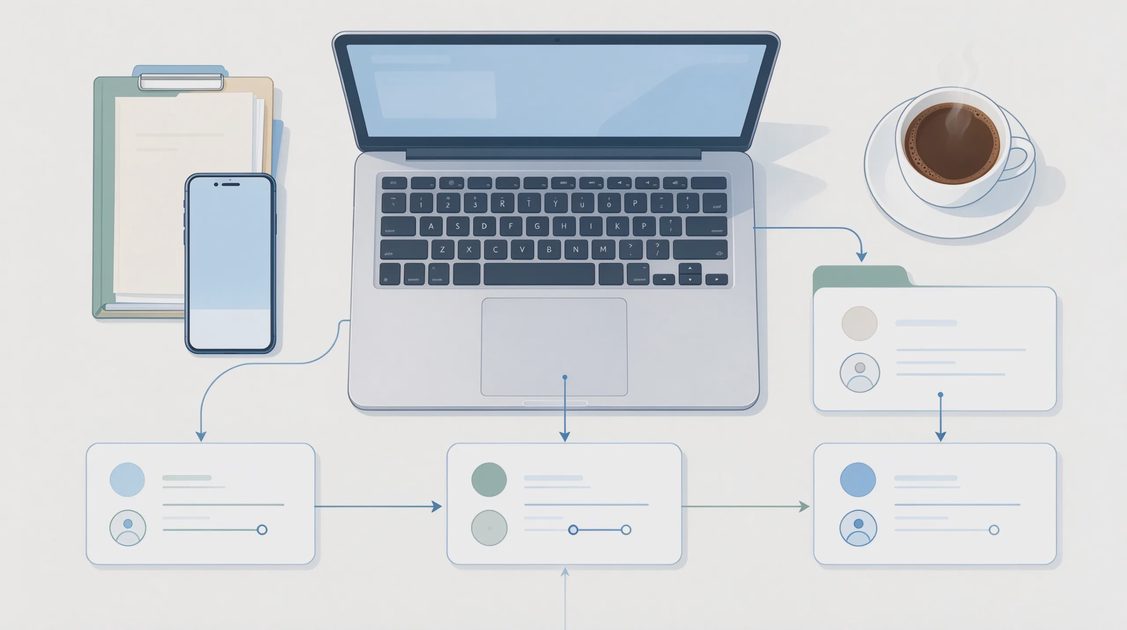
When I help a one-person consulting business design their first intake workflow, we begin with a single page that describes the sequence: lead arrives, qualification questions are answered, notes are cleaned, a human reviews the summary, a proposal draft is created, and the owner makes the final scope decision. Only after that page is clear do we choose tools. The same sequence applies to handoffs, revision tracking, invoice follow-up, and knowledge bases.
Build the Checkpoint Into the Flow
Every client-facing output must pass through a named human question. “Does this summary accurately reflect what the client said, or what I hope they said?” “Is the proposed next step something I am actually willing to deliver?” These questions take minutes. They are the difference between a system that drifts and a system that stays trustworthy.
Write the Maintenance Plan on Day One
If the four maintenance questions do not exist on paper, the system is not finished. It is a prototype. Write them before you celebrate the first successful run. That habit alone prevents most quiet abandonments I see.
A Practical Diagnostic You Can Run This Week
Open any AI workflow you built in the last three months and answer these questions honestly.
Can You Explain It in Three Minutes?
If you cannot describe the entire flow to a colleague without opening a dashboard, the system is already too fragile for daily use. Clarity is the first maintenance requirement.
Is There a Named Checkpoint?
If client-facing output can leave without a human answering a specific question, the system will eventually produce something you regret. Add the checkpoint before you trust the output again.
Do You Know the Privacy Boundary?
If you cannot state exactly what sensitive information is never allowed to enter the automated path, stop using the workflow until that sentence is written. Privacy boundaries are not optional.
Could You Finish the Work Manually?
If the main tool disappeared tomorrow and you could not complete the work with the remaining documents, the system has no fallback. Create the fallback before you need it.
The Quiet Advantage of Maintainable Design
The freelancers and small agencies that keep using AI six months later are not the ones with the most integrations. They are the ones who treated the first version as a draft that needed to survive real life. They built for the version of themselves who would be tired, busy, and slightly skeptical three months later.
That version of you is the real customer of every system you build. Design for that person. Make it useful. Make it checkable. Make it easy to fix. Everything else is optional.

No feedback yet — submit the first.